Privacy Guide for Your Apple iOS 15 Devices
Take 5 minutes to run through the settings on your iOS 15 (iPhone and iPad) security settings to ensure you are not leaking data. This article, originally published in the Palm Beach Bar Association Bulletin, explains the steps in a single page article so you can protect your devices and …
ESI, e-Discovery & Other Tech Issues for Mediators (Florida Dispute Resolution Center Conference 2021)
Thank you to the Florida Dispute Resolution Center for inviting me to speak at the 29th Annual Conference this year. This session focused on: Venmo & recent Florida Bar ethics opinion Defining ESI terms Rules of eDiscovery Steps of eDiscovery (preservation letter, litigation hold, duties, spoliation) 4 recent 2021 eDiscovery …
Christopher Hopkins Discusses Social Media Discovery in 2018 at Palm Beach Bar Association
Special thanks to the Palm Beach Bar Association for inviting me to speak at the CLE, “How to Get Your Claim Move-In Ready for Trial.” Space is still available and you can sign up here. My small portion of the event was to discuss Florida social media discovery as well …
NBI CLE: Facebook, Twitter, Instagram, Email, and Smartphone Evidence (Florida)
Special thanks to National Business Institute (NBI) for hosting this 2-day CLE seminar in Fort Lauderdale, Florida. You can find the seminar information (and download the audio) here. My topics included: Apps and Emerging Technology You Must Know Preserving Electronic Evidence and Avoiding Spoliation Social Media Cases Metadata Made Simple …
Florida Dispute Resolution Conference 2018: Christopher Hopkins Discusses ESI/E-Discovery for Mediators AND Cyber Security and Data Breach for Mediators
Thanks to the Florida Dispute Resolution Conference for inviting me to speak at the 2018 conference. Topics covered: 25 ESI and E-Discovery Terms for Mediators in 75 minutes and Cybersecurity and Data Breach for Mediators. You can download the presentations here and here. If you would like CME points, you …

Third DCA Pharmacy Negligence Case Leaves Florida (Still) Without an ESI Discovery Appellate Opinion
In the case of Walgreen Co. and Holiday CVS, LLC v Jonathan Rubin, two national pharmacy chains were somehow convinced by their counsel to appeal an adverse discovery production order despite the fact that the lawyers failed to get (basic) affidavits establishing that production costs were unreasonably burdensome. In the …

Social Media Discovery in Florida After Nucci v. Target
Litigators and the courts continue to put heavy emphasis on social media discovery but, surprisingly, the case law has not significantly developed in Florida (or really around the country) since the 2015 case of Nucci v. Target. However, the few cases that have arisen in the last two years are …
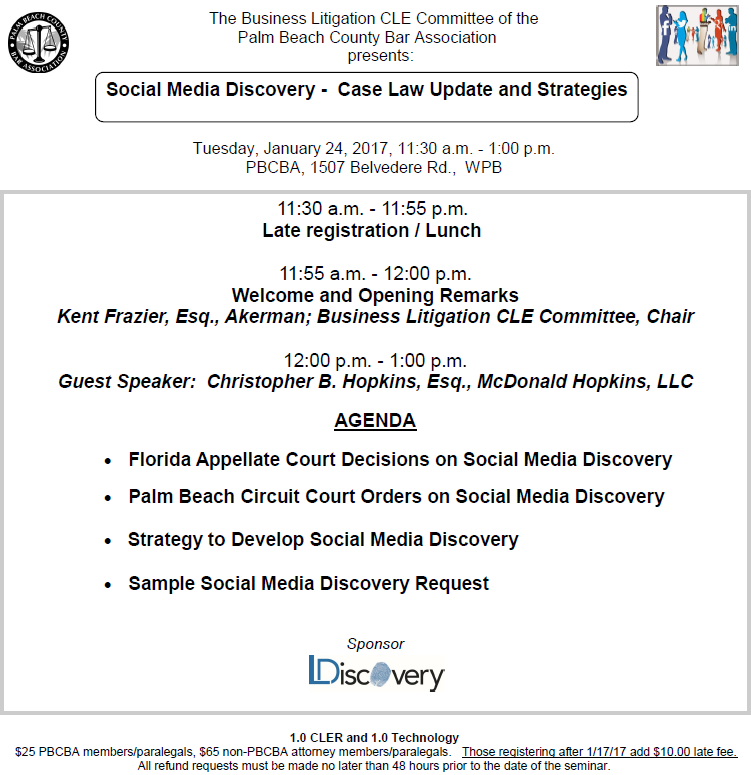
“Social Media Discovery – Case Law Update & Strategies” – Florida Tech CLE at Palm Beach Bar presented by Christopher Hopkins
This one hour session, which you view live or via web (even after the fact), explains the key published opinions in Florida regarding social media discovery. In addition to that, attendees will see the discovery requests which worked AND failed as well as obtain samples of up-to-date discovery requests. Finally, …
Christopher Hopkins Speaks on Social Media Discovery CLE in Palm Beach (Earn Florida Technology CLE points via Web)
Interested in earning some Technology CLE points in Florida? Sign up for this January 24, 2017 CLE — possibly one the first CLEs in the State to offer Tech CLE points. AND… you don’t even have to attend in person. Live or via Web. In one hour we will cover: All …
Will Judge Sasser’s Standing ESI Order Apply to Your Case?
The July/August edition of the Palm Beach Bar Association’s Bulletin includes the article, “Will Judge Sasser’s Standing ESI Order Apply to Your Case?” which you can download, here. The article provides a brief refresher of the 2012 amendments which brought electronically stored information (ESI) within the scope of the Florida …
Can a Court Order Someone to Stay Off Your Website? (Facebook v. Power Ventures says yes)
In Facebook v. Power Ventures, Inc. et al., the Ninth Circuit held that it was a violation of the Computer Fraud and Abuse Act of 1986 for the defendant to continue to access Facebook’s site after receiving a cease and desist letter from Facebook: “a defendant can run afoul of …
Judge Meenu Sasser’s Standing Order on Electronically Stored Information Discovery
Circuit Court Judge Meenu Sasser of the 15th Judicial Circuit Court in and for Palm Beach County, Florida has issued a Standing Order on Electronically Stored Information Discovery which you can download it here. The Order is fairly straightforward but here are the essential elements if your case is in …
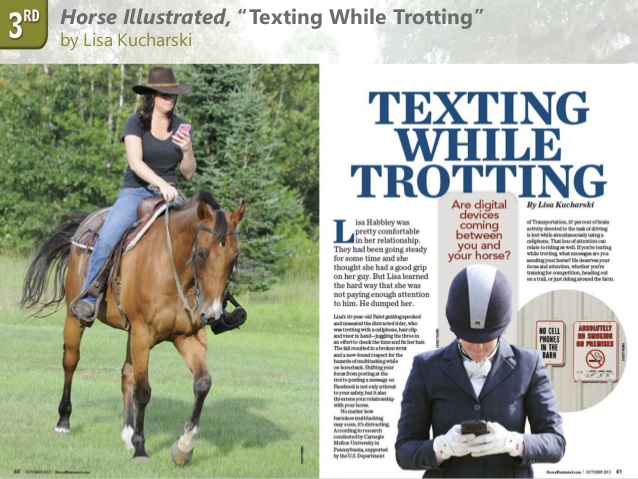
New York Court Horses Around With Facebook Discovery (Forman v. Henkin)
The recent December 17, 2015 opinion in Kelly Forman v. Mark Henkin (NY Appellate Div., First Dept. 2015), provides an otherwise unremarkable discovery opinion except for the dissent, which argues that New York courts are imposing a higher burden on social media discovery. This has led to a fair amount …

Ten Steps to Facebook Discovery
This article, from the Spring 2015 Trial Advocate Quarterly, discusses four (4) reported trial orders and (3) appellate decisions on social media discovery from Florida. While the orders and opinions are not exactly harmonized, they can be interpreted in a way that counsel for parties seeking social media …

Crowe v. Marquette — New Facebook Discovery Case (and possibly lying about it) from Louisiana
In a federal case which appears to be about an employee who claims to be injured on the job, the defendant sought the plaintiff’s Facebook content based upon a lead that the plaintiff had posted that he had been injured while fishing before going to work. So the defendant-employer asked …