Apps for Business Professionals 2013 (Palm Beach Chamber of Commerce)

June 12th, 2013

A special thanks to the Palm Beach Chamber of Commerce for inviting me to speak on June 13, 2013 regarding iPhone and iPad Apps for Business Professionals.logo

If you are interested in attending, the details are here.

The presentation material is here (also on the right column of this page under “Materials”).


Judge Orders Neutral Examiner of Plaintiff’s Facebook Account

May 23rd, 2013

Faced with a dispute over whether a defendant hospital was entitled to access to the plaintiff’s Facebook account, a Pennsylvania judge ordered that a “neutral expert” would be given access to search the plaintiff’s Facebook account for photos of her engaging in physical activity and for references to “snow” (due to alleged evidence she was sledding or undertaking outdoor winter activity).  Apparently, the issue was whether the Facebook content would reveal some evidence that she was acting contrary to her injury claims.facebook1

Typically, as we’ve discussed here before, judges will take one of three approaches: (1) granting access as a normal part of discovery; (2) requiring some threshold indication that there is something discoverable on Facebook; or (3) simply denying the request.

No indication what a “neutral forensic computer expert” may be relative to Facebook.  Maybe a lawyer with a blog?

A full background discussion can be found in Discovery of Facebook Content in Florida Cases.

Case is Perrone v. Lancaster Regional Medical Center (Judge James P. Cullen).

The order is here.

Can the Government Search Your iPhone or iPad at the US Border?

May 17th, 2013

Can Border Patrol rummage through the contents of your digital camera, laptop, smartphones, etc at the border?

Yes, according to several recent cases and a broad exception to the Fourth Amendment (search and seizure).

Read “Can They Search Your iPad or iPhone at the Border?” from the May 2013 Palm Beach County Bar Association Bulletin.

And, yes, that case to the right is for sale here .

Defendants Want Social Media, Plaintiffs Want E-Discovery

May 6th, 2013

In civil lawsuits, particularly those involving individuals as plaintiffs and businesses as defendants, lawyers on either side are turning to new discovery tools that they can use against their opponent without much fear of retribution.  Specifically, a defendant seeks a plaintiff’s social media.  Embarrassing and risky for the plaintiff, perhaps, but likely the defendant-corporation has no social media to be concerned about.  11618616-businessman-with-magnifying-glass-and-suitcase-vector

On the other hand, the plaintiff can serve e-discovery on the defendant: in that situation, the individual plaintiff likely has little to none but the defendant corporation is now scrambling with retention policies, multiple devices, and gobs of data.

Are social media and e-discovery treated the same by the courts?

This article, Defendants Want Social Media, Plaintiffs Want E-Discovery, from the April 2013 Palm Beach Bar Bulletin discusses these (developing) legal trends.

Sending E-Mails To, Sharing Files With Tourist Does Not Create Florida Jurisdiction

April 17th, 2013

Business travelers and vacationers typically send work-related emails while on the road.  It also is not unusual to share files (or access to files) while traveling.  But can that lead to jurisdiction over you in a wayward state?

According to Swanky Apps LLC v. Daren Horning and Roony Invest & Finance, S.A., the answer is “no.”

A dispute arose between the parties and suit was filed in Miami.  The Defendant filed a Motion to Dismiss, raising the lack of personal jurisdiction.

The facts involve the Plaintiff, while temporarily in Florida, making a phone call to Defendant in New York.  While Plaintiff was in Miami, the parties also exchanged emails and Defendant was permitted to remotely access Plaintiff’s computer to download or edit files.  The court repeatedly referenced that the Plaintiff was in Miami “temporarily” which sounds like a business trip or vacation.  The parties have no other Florida contacts.

Bottom line: receiving calls from Miami Beach and exchanging emails and files with someone “temporarily” in Miami, without more, does not create jurisdiction.

Don’t Bring a Video Game to a Gun Fight

March 28th, 2013

In the aftermath of the Sandy Hook and Gabrielle Giffords’ shooting stories (and hundreds others), the National Rifle Association and other gun proponents have argued that video games are a contributing factor — if not the reason — for gun violence in the United States.  It was suggested by the NRA that the Center for Disease Control undertake a study to detect a connection.  mario

We have, however, a long history of blaming entertainment for societal ills… even to the point of Congressional hearings on the comic book.

Moreover, as a legal issue, we’ve been down this road quite recently — the 2011 US Supreme Court decision of Brown v. Entertainment, which discussed these very issues at length as well as the “evidence” surrounding a connection between games and guns.

The article, Don’t Bring a Video Game to a Gun Fight, discusses these issues in the March 2013 Palm Beach Bar Bulletin.

The discussion continues and we could probably clean up much of society in a number of ways to fix gun violence.  Re-read Brown and see how you feel about spending time and money on video games (and whether laws regulating video games are worth the effort).

Florida Court Holds Threat on Facebook to be “Sent” to Victim

March 22nd, 2013

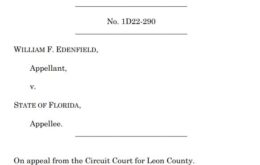
In Timothy Ryan O’Leary v. State of Florida, the First District held that Defendant’s threat of bodily harm posted to his Facebook page was “sent” under Florida Statute 836.10 (“Written Threats to Kill or Do Bodily Harm”) because it was viewed by Defendant’s Facebook friend who was a family member of the victim.

The court held that the statute is violated when (1) a person writes or composes a threat to kill or do bodily harm, (2) the person sends the communication, and (3) the threat is to the recipient or a member of his family.

Here, Defendant went on a rant about a relative, posting on Facebook that he was “gonna fuck you up and bury your bitch ass. [...]  I’ll tear up the concrete with your face and drag you back to your doorstep.”  The entire post is set forth in footnote two of the opinion.

Without comment, the court deemed this post to be a threat to kill or do bodily harm.

The court held that the post was “sent” since the statute was amended in 2010 to include “electronic communication” and that, by the very nature of Facebook, “it is reasonable to presume that the [Defendant] wished to communicate the information to all his Facebook friends.”

Finally, the Defendant had previously sent a Facebook friend request to one of his relatives, Michael.  At the time the post was made, Michael had accepted the request and was a Facebook friend of the Defendant.  Michael showed the post to another relative, who then showed it to the victim (it appears all persons were related).  The court concluded that Michael was the recipient and the threat was directed at a member of Michael’s family.

Both the trial and appellate court made note of the fact that Defendant’s Facebook page was public at the time the post was made.  It appears the trial court relied in part on the public status of the Facebook page when it ruled on whether the post was “sent.”  In what appears to be dicta, the First District notes that “electronic communications” on the Internet are frequently not direct communications but sent to groups on social media sites.  Thus, this opinion may leave to future cases the specific question as to whether a public post on a social media site is “sent” to a victim.

Palm Beach Judge Sasser Rules on Social Media Discovery

February 25th, 2013


In a slip-and-fall personal injury action, Palm Beach County Circuit Court Judge Meenu Sasser entered a January 29, 2013 Order Sustaining Plaintiff’s Objections to Social Networking Discovery.

Judge Sasser’s 11-page opinion enters the fray among other trial and intermediate appellate court opinions on the discoverability of social media information.

Judge Sasser references the 2012 article, Discovery of Facebook Content in Florida Cases, on page 1 (obliquely) and page 5 (directly).

She also discusses the 2011 order in Beswick v. NW. Med. Ctr, 2011 WL 7005038, where the trial court ordered social media production.

US Memo on Drone Strikes vs. Al-Qaida Memo on How to Avoid Them

February 22nd, 2013

A bit off topic of Internet law, the discovery by the Associated Press of an Al Qaida memorandum on how to avoid detection/death from American drones is a technology story worth discussing.  The news coverage on this has been bleak.skynet

On the other hand, there has been plenty of coverage of the U.S. memo entitled the Lawfulness of a Lethal Operation Directed Against U.S. Citizen Who Is A Senior Operational Leader of Al-Qa’ida or an Associated Force.

So now you can read both memos, back-to-back.

The Al Qaida memo has seemingly not hit the news yet  – google “Al Qaida memo drones” and only one story appears in Fast Company, Terrorists May Know How to Avoid Drones, Memo Says.

If you thought that Al Qaida had a lack of technical experience, this memo enumerates 21 ways to avoid drone detection (starting with hiding from under a tree and then it moves towards jamming frequencies).  There is even a discussion of the “War of the Drones” and how, according to Al Qaida, the US moved from F-16 fighters to less expensive drones.  Shockingly, it discusses using a $3,000 system called Skygrabber which you can buy off the internet at Skygrabber.com.  There is a YouTube video showing how Skygrabber can intercept (or at least in 2009) Drone communications.

For context of the US memo, Michael Isakoff’s (NBC) article on the revelation of that report is here.

Special thanks to Gizmodo, which brought the Al Qaida story to our attention (their article includes both the original Arabic as well as link to the English translation, if you are so minded to check that out).

2013 Florida E-Discovery Seminar

February 19th, 2013

Special thanks to the Palm Beach County Bar Association for hosting the CLE, 2013 Florida E-Discovery Seminar.  black-out

This seminar discusses:

1.  Top Ten Things to Know About E-Discovery (from Chin to Zublake, Litigation Hold Letters to Predictive Coding)

2.  New Florida E-Discovery Rules (SC11-1542)

3.  Sample Litigation Hold, Responses, Internal Letters

4.  Social Media Discovery

The Powerpoint for the seminar is here.  The sample letters are here.  Also on the right column of this site under Materials.

Social Media Policy: You’re Probably Doing It Wrong

January 24th, 2013

Countless lawyers and HR professionals bravely set out to craft social media policies without having critical tools: a true working knowledge of social media, a clear direction, common sense, and an up-to-date knowledge of what is allowed by law.  

Don’t trust the lawyer-with-a-facebook-account nor should you task the youngest associate to cut and paste from policies floating on the internet.

Test your company’s or firm’s social media policy against these nine examples to see if it passes muster.

If your business chooses to have a social media policy, hire someone who knows how to write (and update) it.

Special thanks to the Palm Beach Bar for publishing this in the February 2013 Bar Bulletin.  Article is here.

Fawcett v. Altieri: A New York Court Gets Social Media Discovery All Wrong

January 19th, 2013
A New York court has held that, based on a “survey of social media case,” that there is a two prong test for production of Facebook content which includes developing facts before conducting certain discovery.  The court notes that Facebook production is “tantamount to a costly, time consuming fishing expedition…”  Moreover, the decision discusses privacy rights in the context of Facebook posts.
The opinion in Gina Fawcett, individually and as parent of John Fawcett, Jr. v. Nicholas and Gerald Altieri and St. Joseph by the Sea High School.
Assuming this opinion accurately cites to New York procedural rules, they are markedly different than federal (or Florida) standards.
Some issues with the decision:
The court’s “survey” of social media cases… was three cases.  THIS is a survey of social media cases.  Not merely three cases.
That two prong test (supposedly arising from those three cases) prioritizes some forms of discovery over others and turns a blind eye to the wide discovery that’s permitted in business context.
Facebook production is not costly, nor time consuming.  It’s free and easy.  See the 4 steps here.
If there is a case finding Facebook posts to have privacy protections, it’s an outlier.  Most cases hold, like the one New York case, that a post is akin to yelling out the window.
Here in Florida, even a private diary is discoverable.  Suggesting that there has to be some “predicate” before paper discovery puts a magical wall around social media which a party can construct by downplaying or denying what’s inside.
As a side note, see this 2006 Florida Bar Journal article on Electronic Discovery in Florida — a tad outdated after six years, but a good initial primer.

Internet Safety for Parents & Students 2013

January 14th, 2013

Last year we discussed, “there is no delete.”  This year we add to that: social media is not free; the price of admission is your personal information.

A special thanks to Rosarian Academy for allowing me to speak to parents and students in separate sessions so parents can learn tips about social media and how to protect their own privacy as well as start the discussion with their children.  

Likewise, students learned about examples where emails, photos, and Facebook posts which people thought were private… ended up circulated around the globe.  And how that can affect their high school, college, and job applications.  We also discussed illegal downloading and other computer crimes.

The Powerpoint for the parents is here.  The student version is here.

What the Patreaus Scandal Tells Us About Email Privacy

January 11th, 2013

This article discusses the Patreaus affair from the standpoint of practical email privacy tips for lawyers, law firms, their clients, and families.

A brief explanation is provided how emails (or even fake email addresses) are traceable with free software and what data exists on the person’s computer to show what sites have been viewed.

This article appeared in the January 2013 edition of the Palm Beach Bar Association Bulletin.

What Does a Child Pornography Case Tell You About Computer Evidence?

January 5th, 2013

Want to know how to find (or hide) on a computer what websites were visited, what images were viewed, and what files were deleted?  Even if you are not a computer forensic specialist, you can find this information using basic steps and free software on the Internet.  This is helpful for inhouse counsel, lawyers, and even parents.

Surprisingly, these steps are considered so easy, that Judge Posner of the Seventh Circuit stopped short of claming, “even a judge could do this.”  Instead, he notes that “despite the availability of software for obliterating or concealing incriminating computer files, the use of such software is surprisingly rare.”  Well, maybe.  CCleaner remains a frequently-sought program at Download.com.  The case is United States v. Seiver.

Learn computer steps and evidence standards in the November 2012 article from the Palm Beach Bar Association, What Does a Child Pornography Case Tell You About Computer Evidence?